Category: blog

Learning how to quilt: You will make mistakes

Learning how to quilt: You will make mistakes

Is learning to quilt on your bucket list? Do you think it looks too intimidating? Stop convincing yourself not to try! It’s only intimidating if you’re afraid to make mistakes, but making mistakes is how you learn. Let me tell you about my first quilt. I wish I had a photo of it to show you.

I’ve always liked to make things. I love color, texture, design, everything that goes into making beautiful things. I tend to find something I like and then I dive into it without checking how deep the water is. Sometimes it works out, other times, well, let’s just say there’s a reason why I don’t do some crafts. 

One day, I decided I wanted to learn how to quilt. I have no idea where that came from. There were no quilters in my life. I had never even seen a handmade quilt. But I wanted to make a quilt. I bought The Weekend Quilt by Leslie Linsley and set out to make a quilt. But not just any quilt. Oh no. I don’t do things small. I decided on a queen size double Irish chain quilt top. Of course I did. 

I followed the instructions but despite my perfectionist tendencies, there are times when I’m not known for my exactness. I didn’t know or realize how vital it was to make sure I had ¼ inch seams in my top. (That learning came later!) I used some blue cotton (I think) and I believe the white was a sheet. So was my backing. Anyway, I pieced the top, bought a frame, sandwiched the quilt and began quilting. Except – this was before YouTube. I didn’t know how and I didn’t know anyone to ask. So, I stabbed the needle through the top, pulled it out the bottom, blindly stabbed it back up and pulled it through the top. 

When it was done, the top didn’t look half bad. The backing was a whole other story. But then I figured that no one would see the back and I proudly put that quilt on our bed. We used it for several years, even though some seams were splitting (those darned not quite ¼” seams). Eventually, I replaced it with a beautiful hand quilted whole cloth quilt and the blue one because the dog’s quilt for several more years. It had a good life.

So you see, I made a ton of mistakes with that quilt. But it was still used and loved. And because of those mistakes, I learned what I shouldn’t do, so my next quilt was a bit better. And the next one a bit better. Eventually, I reached where I am now. 

Here are some things to remember if you feel nervous about starting a quilt:

  • Start small. Do NOT do what I did. Baby quilts, placemats, table runners are all good first pieces to make. 
  • Buy as good material as you can afford. For sure, quilt shop fabrics are preferred for good quilts and the better your fabric, the better your project will turn out. But not everyone can afford quilt shop prices, especially while learning, so you do what you can afford to do and what you’re comfortable doing. The only thing is that it really should be 100% cotton, quilting cotton – not the thicker cotton for sewing clothing. Some experienced quilters do use polyester or poly blends, but I believe that when you’re learning, you should stick to quilting cotton. It’s consistent and easy to use. 
  • If you have to buy a sewing machine, again but the best you can afford. I never advise buying the cheapest machines on the market because they can be tough to use. And if a machine doesn’t sew well, you will likely become discouraged and hate the process. You don’t need a fancy machine that costs several thousands of dollars.  You only need a basic machine that sews well. Go to quilt shops or machine stores that allow you to try their machines. If you buy locally, you have a good resource if you run into any problems. You can also buy secondhand, online or in person. Spread the word that you’re looking for a machine and often someone will know of one that’s for sale. 
  • Give yourself time to get used to the process. Read blogs and articles for beginner quilters. Watch YouTube videos. If you have a local quilt shop, see if they offer classes. There’s no rush and no race to the finish line. 
  • Ask for help. There are many Facebook groups for quilters. Consider joining at least one where you can learn from others and ask your own questions.

Quilting is a journey, one that is filled with discovery and beauty. If quilting is what you want to do, go for it!
Finding Your Sewing Space

Finding Your Sewing Space

Sometimes I read quilting blogs or watch YouTube videos and my jaw drops at some of the quilting rooms and sewing space. They’re huge, bright, airy, and full of great quilty toys. But not everyone can do that. I know I can’t.

When I first began quilting, I used the kitchen table. I had two toddlers at the time, so I had to be extra careful with pins and other sharp tools. I also had limited time because was working as an RN, along with raising the kids with my husband (a third child followed not long after). 

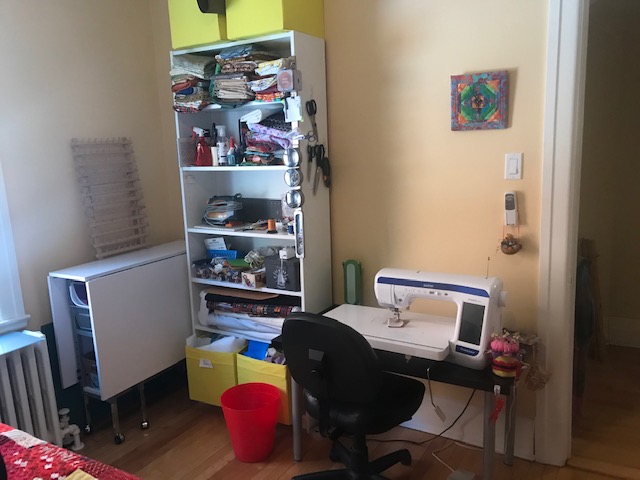
We eventually moved into a larger house and I had the corner of a dining room to use. That still wasn’t ideal. But at least I didn’t have to put my machine away every time we needed the kitchen table. When my kids grew up and away, I inherited a spare room. This was a room I could turn into my own space! Sadly, I lost that space when we downsized and once again, I was relegated to the dining room. Finally, all the chickies flew the nest and I ended up with this larger, more comfortable space.

So, what do you need in a sewing space? Really, all you need is a sturdy table for your machine, enough space on a table for your cutting mat and fabric, good lighting and you’re good to go. If you’re hand quilting, you may need enough space for a stand-up hoop or frame. I used to use frames and hoops, but I don’t any more. I just hold the quilt in my lap and let gravity pull down on the fabric to give me enough tension.

If your space is temporary, like my kitchen table was, a plastic tub that can hold your current projects is a big help. You can just pop everything back in there and know that it’s all in the same place. Some quilters have carved space out of closets. They take the door off, install lighting and a good table, and a tiny quilting space now exists. 

You may need to be creative to make your own space, but most of the time, it is possible. Check out Pinterest for ideas. Just look for sewing rooms or sewing nooks. Remember that a successful quilt does not depend on having all the bells and whistles of a large sewing studio. You only need a bit of space and the desire to create your first quilt.

My Longarm – I Hate Waiting

My Longarm – I Hate Waiting

Just before Christmas last year, I put in an order for a Q’Nique 15r and an 8ft Continuum frame. Some people call it a midarm, but it’s easier to call it a longarm – and Grace Company calls it a longarm. I hadn’t planned on buying the machine quite yet, but there was a great deal that I couldn’t pass up. I was told there would be a 2-week wait for the machine to be delivered from out west. 

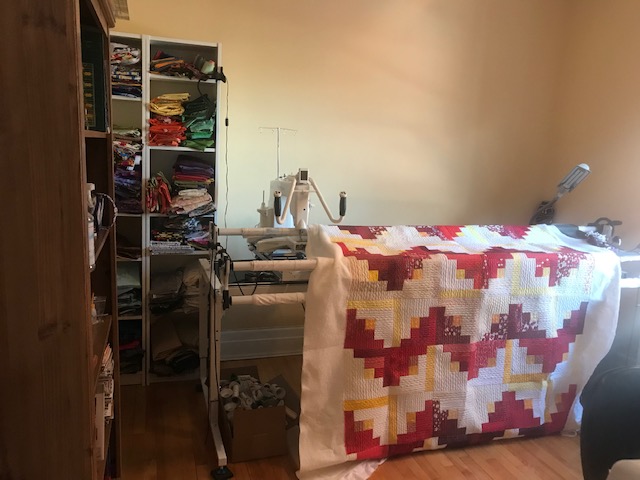
my longarm machine, a q'nique15 pro on a continuum frame, from Grace company.

As much as I hate to wait for new toys, the timing was quite good. With the Christmas holidays at hand, I was busy and the wait gave me the chance to learn as much as I could about longarm quilting. I watched multiple YouTube videos, joined a few longarm-related Facebook pages, and read many blog posts. I moved rooms around to accommodate the large frame and I sewed up several quilt tops that I would eventually use as I learned how to use my new machine. 

The longarm arrived but…

Sure enough, the machine arrived in 2 weeks, but it would be another week before the technician could bring it and set it up. I could have gone to the store and brought it home, but since the store provided set up and a quick lesson on the machine basics, that seemed like a silly choice. I knew I needed something to learn on. Some people use sheets for learning, but using sheets is debatable among longarmers. Some hate them, others don’t mind. So I decided on a different approach.

Like most long-time quilters, I have a fair sized fabric stash. Some of my pieces go back almost 20 years. If I’ve not used them by now, I am pretty sure I won’t use them at all. So I went through my stash and pulled out all the fabric I knew I wouldn’t use because it was too old or it was too ugly. What was I thinking when I bought that?! I pieced them all together to make an ugly mismatched but useful couple of quilt tops. These were for practice, I could even stitch over in another colour, to practice my stitches and movements. I thought that having seams and intersections made practicing more realistic. Once done, they made for perfect dog blankets for a friend and a local greyhound adoption group. Remember, quilters don’t like to waste anything.